

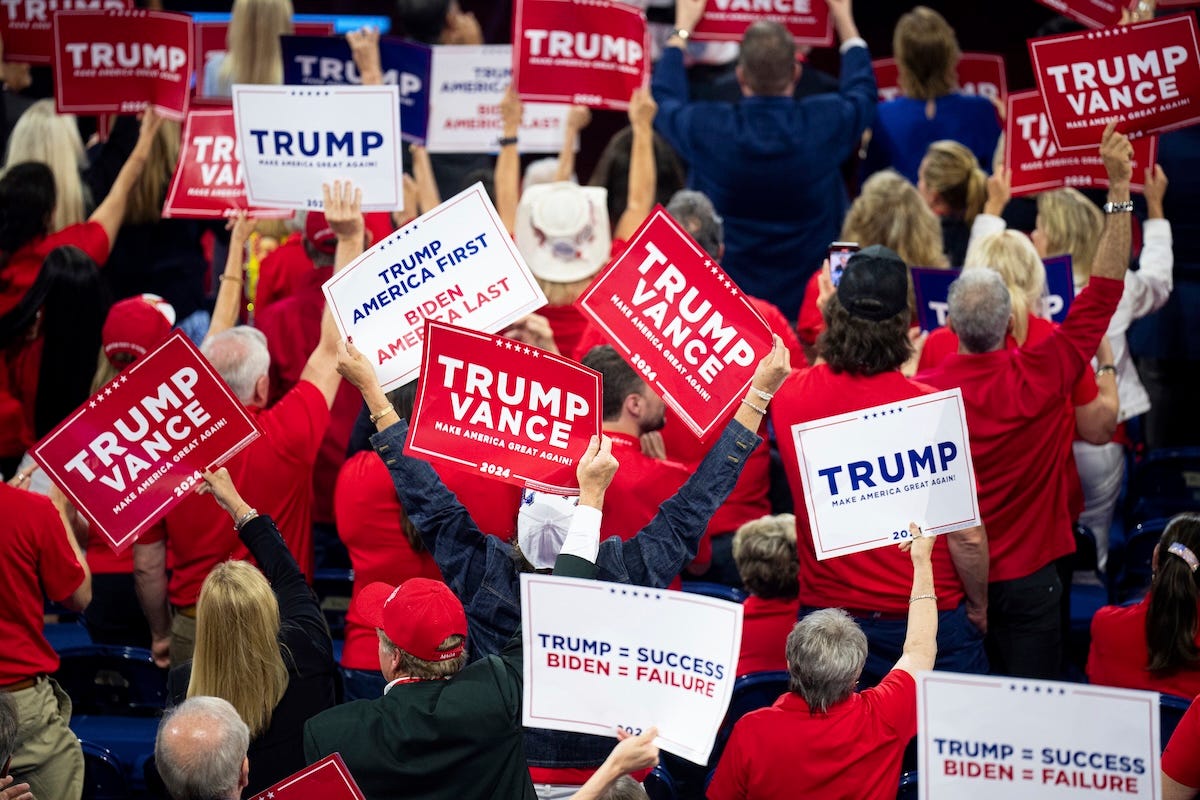
The most imaginative president since Franklin Delano Roosevelt, Donald Trump has done it again. He has invented a new institution that might just give the Republican Party the advantage in midterm elections. “I am thinking of recommending a National Convention to the Republican Party, just prior to the Midterms. It has never been done before,” the president proclaimed on Truth Social. Trump’s innovation could go awry, of course, just as Roosevelt misfired when he attempted to pack the Supreme Court. But a Republican convention in 2026 could strengthen the party organization, consolidate the nomination of Trump’s chosen successor, retain the Senate, and, perhaps, if the president is dumb lucky, fight off an otherwise likely setback in the House of Representatives.
AP Images
“I’m all excited. . . . That’s genius.,” House Speaker Mike Johnson, said. “I was on the road out west, maybe a week ago, when the president called, at like 6:30 in the morning, and said, ‘Mike, I have a great idea. How about a midterm thing?’” .
The president’s thinking could have been stimulated by rumors that Democrats were considering a large national assembly of their own. “To showcase our tremendous candidates [we may host] a large-scale gathering before the midterms,” a Democratic official confided to a reporter.
According to insiders, Republicans will hold the event early next year, a time when the publicity can be used to raise funding and generate enthusiasm among the party base for senatorial candidates in tight races. The four-vote Senate margin in the Senate once seemed beyond the reach of the Democratic party, but a combination of Republican retirements and strong Democratic contenders has given Charles Schumer hope that he will soon become majority leader. Republican members of the House of Representatives running in close races can also be given television time that can be used in ads and broadcasts by local stations. Mid-terms are typically won by the party not in control of the presidency, but a convention could provide the extra kick needed to retain Johnson and Senate Majority Leader John Thune in their leadership roles.
JD Vance could be the big winner among the emerging presidential hopefuls. As vice-president, his main official responsibility is to break tie votes in the Senate, giving him the time to tour the country in support of delegates to the mid-term convention. His chief rival, Secretary of State Marco Rubio, is responsible for managing diplomatic relationships abroad. Other rivals, such as Florida governor Ron DeSantis, Texas governor Gregg Abbott, and a fistful of presidential aspirants in the Senate all have day jobs with time-consuming responsibilities. All bets are off, however, if Vance stumbles or begins to upstage the master conductor in the White House.
A mid-term convention is likely to be downplayed by the mainstream media, but conservative outlets, like Fox News, New York Post, Washington Times, Free Press and many other alternative outlets—conservative radio, right-wing TV, influencers, pro-Trump podcasts-- will provide wall-to-wall print, radio and television coverage.
Design of the convention process is up in the air. In a gross under-statement, Mike Johnson cheerfully admits, “All we have to do now is find the right location and get this thing planned.” If a standard convention model is used to select delegates, the mid-term convention could do much to strengthen the structural core of the Republican state and local party organization. For decades, primary elections have replaced party caucuses as the main vehicle for selecting nominees for public office and delegates to national conventions, undermining the role of party organizations. Party endorsements count for little in primaries when other candidates have money or glamour. Billionaires, television commentators, movie stars, astronauts, and generals all run well against workhorses who have labored in the party’s trenches for years. A convention model with delegates selected by caucuses that begin at the precinct level will give party organizations an opportunity to regain a portion of the strength lost to outsiders with independent financial resources.
The ironies are obvious. Trump, the chief destroyer of the traditional Republican party organization, will have the opportunity to build a new organization under the same name filled with loyalists committed to his agenda. He already can intimidate Republican members of Congress by threatening them with opposition in primary campaigns. By holding a mid-term convention, Trump can redesign the very structure of the Republican party along lines he prefers.
Will Democrats follow suit? They tried out something along these lines in the 1970s, only to discard them as a distraction. But if a Trump-led convention is to be held, they will need to find a way to respond. If they settle on choosing delegates by caucuses that begin at the precinct level, watch for a strong push from the progressive wing of the party. Left-leaning college students have the time and enthusiasm to attend precinct caucuses, young reporters will give the contests the needed coverage, and progressive presidential candidates will have a national stage upon which to perform.
Of course, all of this could turn out quite differently than anticipated. Early publicity may prove fatal for over-exposed candidates. Positions will be taken that cannot be defended in the general election. Those who flash across the sky in early evening may morph into falling stars before daybreak. Trump’s invention may be nothing other than a one-time wonder. Yet mid-term conventions seem well designed for a political world where electoral campaigns never cease.
__________________________________________________________________
Paul E. Peterson is a senior fellow at the Hoover Institution, Stanford University and a professor of government at Harvard University.